Friday, March 18, 2011

Saturn


Saturn is the sixth planet from the Sun and is the second largest in the solar system with an equatorial diameter of 119,300 kilometers (74,130 miles). Much of what is known about the planet is due to the Voyager explorations in 1980-81. Saturn is visibly flattened at the poles, a result of the very fast rotation of the planet on its axis. Its day is 10 hours, 39 minutes long, and it takes 29.5 Earth years to revolve about the Sun. The atmosphere is primarily composed of hydrogen with small amounts of helium and methane. Saturn is the only planet less dense than water (about 30 percent less). In the unlikely event that a large enough ocean could be found, Saturn would float in it. Saturn's hazy yellow hue is marked by broad atmospheric banding similar to, but fainter than, that found on Jupiter

The wind blows at high speeds on Saturn. Near the equator, it reaches velocities of 500 meters a second (1,100 miles an hour). The wind blows mostly in an easterly direction. The strongest winds are found near the equator and velocity falls off uniformly at higher latitudes. At latitudes greater than 35 degrees, winds alternate east and west as latitude increases.

Saturn's ring system makes the planet one of the most beautiful objects in the solar system. The rings are split into a number of different parts, which include the bright A and B rings and a fainter C ring. The ring system has various gaps. The most notable gap is the Cassini [kah-SEE-nee] Division, which separates the A and B rings. Giovanni Cassini discovered this division in 1675. The Encke [EN-kee] Division, which splits the A Ring, is named after Johann Encke, who discovered it in 1837. Space probes have shown that the main rings are really made up of a large number of narrow ringlets. The origin of the rings is obscure. It is thought that the rings may have been formed from larger moons that were shattered by impacts of comets and meteoroids. The ring composition is not known for certain, but the rings do show a significant amount of water. They may be composed of icebergs and/or snowballs from a few centimeters to a few meters in size. Much of the elaborate structure of some of the rings is due to the gravitational effects of nearby satellites. This phenomenon is demonstrated by the relationship between the F-ring and two small moons that shepherd the ring material.

Radial, spoke-like features in the broad B-ring were also found by the Voyagers. The features are believed to be composed of fine, dust-size particles. The spokes were observed to form and dissipate in the time-lapse images taken by the Voyagers. While electrostatic charging may create spokes by levitating dust particles above the ring, the exact cause of the formation of the spokes is not well understood.

Uranus


Uranus is the seventh planet from the Sun and is the third largest in the solar system. It was discovered by William Herschel in 1781. It has an equatorial diameter of 51,800 kilometers (32,190 miles) and orbits the Sun once every 84.01 Earth years. It has a mean distance from the Sun of 2.87 billion kilometers (1.78 billion miles). It rotates about its axis once every 17 hours 14 minutes. Uranus has at least 22 moons. The two largest moons, Titania and Oberon, were discovered by William Herschel in 1787.

The atmosphere of Uranus is composed of 83% hydrogen, 15% helium, 2% methane and small amounts of acetylene and other hydrocarbons. Methane in the upper atmosphere absorbs red light, giving Uranus its blue-green color. The atmosphere is arranged into clouds running at constant latitudes, similar to the orientation of the more vivid latitudinal bands seen on Jupiter and Saturn. Winds at mid-latitudes on Uranus blow in the direction of the planet's rotation. These winds blow at velocities of 40 to 160 meters per second (90 to 360 miles per hour). Radio science experiments found winds of about 100 meters per second blowing in the opposite direction at the equator.

Uranus is distinguished by the fact that it is tipped on its side. Its unusual position is thought to be the result of a collision with a planet-sized body early in the solar system's history. Voyager 2 found that one of the most striking influences of this sideways position is its effect on the tail of the magnetic field, which is itself tilted 60 degrees from the planet's axis of rotation. The magnetotail was shown to be twisted by the planet's rotation into a long corkscrew shape behind the planet. The magnetic field source is unknown; the electrically conductive, super-pressurized ocean of water and ammonia once thought to lie between the core and the atmosphere now appears to be nonexistent. The magnetic fields of Earth and other planets are believed to arise from electrical currents produced in their molten cores.

Uranus' Rings

In 1977, the first nine rings of Uranus were discovered. During the Voyager encounters, these rings were photographed and measured, as were two other new rings and ringlets. Uranus' rings are distinctly different from those at Jupiter and Saturn. The outermost epsilon ring is composed mostly of ice boulders several feet across. A very tenuous distribution of fine dust also seems to be spread throughout the ring system.

There may be a large number of narrow rings, or possibly incomplete rings or ring arcs, as small as 50 meters (160 feet) in width. The individual ring particles were found to be of low reflectivity. At least one ring, the epsilon, was found to be gray in color. The moons Cordelia and Ophelia act as shepherd satellites for the epsilon ring.

Neptune


Neptune is the outermost planet of the gas giants. It has an equatorial diameter of 49,500 kilometers (30,760 miles). If Neptune were hollow, it could contain nearly 60 Earths. Neptune orbits the Sun every 165 years. It has eight moons, six of which were found by Voyager. A day on Neptune is 16 hours and 6.7 minutes. Neptune was discovered on September 23, 1846 by Johann Gottfried Galle, of the Berlin Observatory, and Louis d'Arrest, an astronomy student, through mathematical predictions made by Urbain Jean Joseph Le Verrier.

The first two thirds of Neptune is composed of a mixture of molten rock, water, liquid ammonia and methane. The outer third is a mixture of heated gases comprised of hydrogen, helium, water and methane. Methane gives Neptune its blue cloud color.

Neptune is a dynamic planet with several large, dark spots reminiscent of Jupiter's hurricane-like storms. The largest spot, known as the Great Dark Spot, is about the size of the earth and is similar to the Great Dark Spot on Jupiter. Voyager revealed a small, irregularly shaped, eastward-moving cloud scooting around Neptune every 16 hours or so. This scooter as it has been dubbed could be a plume rising above a deeper cloud deck.

Long bright clouds, similar to cirrus clouds on Earth, were seen high in Neptune's atmosphere. At low northern latitudes, Voyager captured images of cloud streaks casting their shadows on cloud decks below.

The strongest winds on any planet were measured on Neptune. Most of the winds there blow westward, opposite to the rotation of the planet. Near the Great Dark Spot, winds blow up to 2,000 kilometers (1,200 miles) an hour.

Neptune has a set of four rings which are narrow and very faint. The rings are made up of dust particles thought to have been made by tiny meteorites smashing into Neptune's moons. From ground based telescopes the rings appear to be arcs but from Voyager 2 the arcs turned out to be bright spots or clumps in the ring system. The exact cause of the bright clumps is unknown.

The magnetic field of Neptune, like that of Uranus, is highly tilted at 47 degrees from the rotation axis and offset at least 0.55 radii (about 13,500 kilometers or 8,500 miles) from the physical center. Comparing the magnetic fields of the two planets, scientists think the extreme orientation may be characteristic of flows in the interior of the planet and not the result of that planet's sideways orientation or of any possible field reversals at either planet.

Dwarf Planet Pluto


Although Pluto was discovered in 1930, limited information on the distant object delayed a realistic understanding of its characteristics. Pluto is the second largest known dwarf planet and tenth largest orbiting the Sun. From its time of discovery in 1930 to 2006 it was considered to be the ninth planet in the solar system, but because additional objects have been discovered including Eris which is 27% more massive, the IAU reclassified Pluto and the other objects as dwarf planets. The New Horizons spacecraft was launched on January 16, 2006 and will make its closest approach to Pluto on July 14, 2015. This mission will provide an increased amount of information about this peculiar dwarf planet. The uniqueness of Pluto's orbit, rotational relationship with its satellite, spin axis, and light variations all give it a certain appeal.

Pluto is usually farther from the Sun than any of the eight planets; however, due to the eccentricity of its orbit, it is closer than Neptune for 20 years out of its 249 year orbit. Pluto crossed Neptune's orbit January 21, 1979, made its closest approach September 5, 1989, and remained within the orbit of Neptune until February 11, 1999. This will not occur again until September 2226.

Pluto's rotation period is 6.387 days, the same as its satellite Charon. Although it is common for a satellite to travel in a synchronous orbit with its planet, Pluto rotates synchronously with the orbit of its satellite. Thus being tidally locked, Pluto and Charon continuously face each other as they travel through space.

Unlike most planets, but similar to Uranus, Pluto rotates with its poles almost in its orbital plane. Pluto's rotational axis is tipped 122 degrees. When Pluto was first discovered, its relatively bright south polar region was the view seen from the Earth. Pluto appeared to grow dim as our viewpoint gradually shifted from nearly pole-on in 1954 to nearly equator-on in 1973. Pluto's equator is now the view seen from Earth.

During the period from 1985 through 1990, Earth was aligned with the orbit of Charon around Pluto such that an eclipse could be observed every Pluto day. This provided opportunity to collect significant data which led to albedo maps defining surface reflectivity, and to the first accurate determination of the sizes of Pluto and Charon, including all the numbers that could be calculated therefrom.

The first eclipses (mutual events) began blocking the north polar region. Later eclipses blocked the equatorial region, and final eclipses blocked Pluto's south polar region. By carefully measuring the brightness over time, it was possible to determine surface features. It was found that Pluto has a highly reflective south polar cap, a dimmer north polar cap, and both bright and dark features in the equatorial region. Pluto's geometric albedo is 0.49 to 0.66, which is much brighter than Charon. Charon's albedo ranges from 0.36 to 0.39.

The eclipses lasted as much as four hours and by carefully timing their beginning and ending, measurements for their diameters were taken. The diameters can also be measured directly to within about 1 percent by more recent images provided by the Hubble Space Telescope. These images resolve the objects to clearly show two separate disks. The improved optics allow us to measure Pluto's diameter as 2,274 kilometers (1413 miles) and Charon's diameter as 1,172 kilometers (728 miles), just over half the size of Pluto. Their average separation is 19,640 km (12,200 miles). That's roughly eight Pluto diameters.

Average separation and orbital period are used to calculate Pluto and Charon's masses. Pluto's mass is about 6.4 x 10⁻⁹ solar masses. This is close to 7 (was 12 x's) times the mass of Charon and approximately 0.0021 Earth mass, or a fifth of our moon.

Pluto's average density lies between 1.8 and 2.1 grams per cubic centimeter. It is concluded that Pluto is 50% to 75% rock mixed with ices. Charon's density is 1.2 to 1.3 g/cm3, indicating it contains little rock. The differences in density tell us that Pluto and Charon formed independently, although Charon's numbers derived from HST data are still being challenged by ground based observations. Pluto and Charon's origin remains in the realm of theory.

Pluto's icy surface is 98% nitrogen (N2). Methane (CH4) and traces of carbon monoxide (CO) are also present. The solid methane indicates that Pluto is colder than 70 Kelvin. Pluto's temperature varies widely during the course of its orbit since Pluto can be as close to the sun as 30 AU and as far away as 50 AU. There is a thin atmosphere that freezes and falls to the surface as the planet moves away from the Sun. The atmospheric pressure deduced for Pluto's surface is 1/100,000 that of Earth's surface pressure.


Asteroid


Asteroids are rocky and metallic objects that orbit the Sun but are too small to be considered planets. They are known as minor planets. Asteroids range in size from Ceres, which has a diameter of about 1000 km, down to the size of pebbles. Sixteen asteroids have a diameter of 240 km or greater. They have been found inside Earth's orbit to beyond Saturn's orbit. Most, however, are contained within a main belt that exists between the orbits of Mars and Jupiter. Some have orbits that cross Earth's path and some have even hit the Earth in times past. One of the best preserved examples is Barringer Meteor Crater near Winslow, Arizona.

Asteroids are material left over from the formation of the solar system. One theory suggests that they are the remains of a planet that was destroyed in a massive collision long ago. More likely, asteroids are material that never coalesced into a planet. In fact, if the estimated total mass of all asteroids was gathered into a single object, the object would be less than 1,500 kilometers (932 miles) across -- less than half the diameter of our Moon.

Much of our understanding about asteroids comes from examining pieces of space debris that fall to the surface of Earth. Asteroids that are on a collision course with Earth are called meteoroids. When a meteoroid strikes our atmosphere at high velocity, friction causes this chunk of space matter to incinerate in a streak of light known as a meteor. If the meteoroid does not burn up completely, what's left strikes Earth's surface and is called a meteorite.

Of all the meteorites examined, 92.8 percent are composed of silicate (stone), and 5.7 percent are composed of iron and nickel; the rest are a mixture of the three materials. Stony meteorites are the hardest to identify since they look very much like terrestrial rocks.

Because asteroids are material from the very early solar system, scientists are interested in their composition. Spacecraft that have flown through the asteroid belt have found that the belt is really quite empty and that asteroids are separated by very large distances. Before 1991 the only information obtained on asteroids was though Earth based observations. Then on October 1991 asteroid 951 Gaspra was visited by the Galileo spacecraft and became the first asteroid to have hi-resolution images taken of it. Again on August 1993 Galileo made a close encounter with asteroid 243 Ida. This was the second asteroid to be visited by spacecraft. Both Gaspra and Ida are classified as S-type asteroids composed of metal-rich silicates.

On June 27, 1997 the spacecraft NEAR made a high-speed close encounter with asteroid 253 Mathilde. This encounter gave scientists the first close-up look of a carbon rich C-type asteroid. This visit was unique because NEAR was not designed for flyby encounters. NEAR is an orbiter destined for asteroid Eros in January of 1999.

Astronomers have studied a number of asteroids through Earth-based observations. Several notable asteroids are Toutatis,Castalia,Geographos and Vesta. Astronomers studied Toutatis, Geographos and Castalia using Earth-based radar observations during close approaches to the Earth. Vesta was observed by the Hubble Space Telescope.


Meteoroids and Meteorites


The term meteor comes from the Greek meteoron, meaning phenomenon in the sky. It is used to describe the streak of light produced as matter in the solar system falls into Earth's atmosphere creating temporary incandescence resulting from atmospheric friction. This typically occurs at heights of 80 to 110 kilometers (50 to 68 miles) above Earth's surface. The term is also used loosely with the word meteroid referring to the particle itself without relation to the phenomena it produces when entering the Earth's atmosphere. A meteoroid is matter revolving around the sun or any object in interplanetary space that is too small to be called an asteroid or a comet. Even smaller particles are called micrometeoroids or cosmic dust grains, which includes any interstellar material that should happen to enter our solar system. A meteorite is a meteoroid that reaches the surface of the Earth without being completely vaporized.

One of the primary goals of studying meteorites is to determine the history and origin of their parent bodies. Several achondrites sampled from Antarctica since 1981 have conclusively been shown to have originated from the moon based on compositional matches of lunar rocks obtained by the Apollo missions of 1969-1972. Sources of other specific metorites remain unproven, although another set of eight achondrites are suspected to have come from Mars. These meteorites contain atmospheric gases trapped in shock melted minerals which match the composition of the Martian atmosphere as measured by the Viking landers in 1976. All other groups are presumed to have originated on asteroids or comets; the majority of meteorites are believed to be fragments of asteroids.

Meteorites have proven difficult to classify, but the three broadest groupings are stony, stony iron, and iron. The most common meteorites are chondrites, which are stony meteorites. Radiometric dating of chondrites has placed them at the age of 4.55 billion years, which is the approximate age of the solar system. They are considered pristine samples of early solar system matter, although in many cases their properties have been modified by thermal metamorphism or icy alteration. Some meteoriticists have suggested that the different properties found in various chondrites suggest the location in which they were formed. Enstatite chondrites contain the most refractory elements and are believed to have formed in the inner solar system. Ordinary chondrites, being the most common type containing both volatile and oxidized elements, are thought to have formed in the inner asteroid belt. Carbonaceous chondrites, which have the highest proportions of volatile elements and are the most oxidized, are thought to have originated in even greater solar distances. Each of these classes can be further subdivided into smaller groups with distinct properties.

Other meteorite types which have been geologically processed are achondrites, irons and pallasites. Achondrites are also stony meteorites, but they are considered differentiated or reprocessed matter. They are formed by melting and recrystallization on or within meteorite parent bodies; as a result, achondrites have distinct textures and mineralogies indicative of igneous processes. Pallasites are stony iron meteorites composed of olivine enclosed in metal. Iron meteorites are classified into thirteen major groups and consist primarily of iron-nickel alloys with minor amounts of carbon, sulfur, and phosphorus. These meteorites formed when molten metal segregated from less dense silicate material and cooled, showing another type of melting behavior within meteorite parent bodies. Thus, meteoritescontain evidence of changes that occurred on the parent bodies from which they were removed or broken off, presumably by impacts, to be placed in the first of many revolutions.

The motion of meteoroids can be severely perturbed by the gravitational fields of major planets. Jupiter's gravitational influence is capable of reshaping an asteroid's orbit from the main belt so that it dives into the inner solar system and crosses the orbit of Earth. This is apparently the case of the Apollo and Vesta asteroid fragments.

Particles found in highly correlated orbits are called a stream components and those found in random orbits are called sporadic components. It is thought that most meteor streams are formed by the decay of a comet nucleus and consequently are spread around the original orbit of the comet. When Earth's orbit intersects a meteor stream, the meteor rate is increased and a meteor shower results. A meteor shower typically will be active for several days. A particularly intense meteor shower is called a meteor storm. Sporadic meteors are believed to have had a gradual loss of orbital coherence with a meteor shower due to collisions and radiative effects, further enhanced by gravitational influences. There is still some debate concerning sporadic meteors and their relationship with showers.

Comets


Comets are small, fragile, irregularly shaped bodies composed of a mixture of non-volatile grains and frozen gases. They have highly elliptical orbits that bring them very close to the Sun and swing them deeply into space, often beyond the orbit of Pluto.

Comet structures are diverse and very dynamic, but they all develop a surrounding cloud of diffuse material, called a coma, that usually grows in size and brightness as the comet approaches the Sun. Usually a small, bright nucleus (less than 10 km in diameter) is visible in the middle of the coma. The coma and the nucleus together constitute the head of the comet.

As comets approach the Sun they develop enormous tails of luminous material that extend for millions of kilometers from the head, away from the Sun. When far from the Sun, the nucleus is very cold and its material is frozen solid within the nucleus. In this state comets are sometimes referred to as a "dirty iceberg" or "dirty snowball," since over half of their material is ice.When a comet approaches within a few AU of the Sun, the surface of the nucleus begins to warm, and volatiles evaporate. The evaporated molecules boil off and carry small solid particles with them, forming the comet's coma of gas and dust.

When the nucleus is frozen, it can be seen only by reflected sunlight. However, when a coma develops, dust reflects still more sunlight, and gas in the coma absorbs ultraviolet radiation and begins to fluoresce. At about 5 AU from the Sun, fluorescence usually becomes more intense than reflected light.

As the comet absorbs ultraviolet light, chemical processes release hydrogen, which escapes the comet's gravity, and forms a hydrogen envelope. This envelope cannot be seen from Earth because its light is absorbed by our atmosphere, but it has been detected by spacecraft.

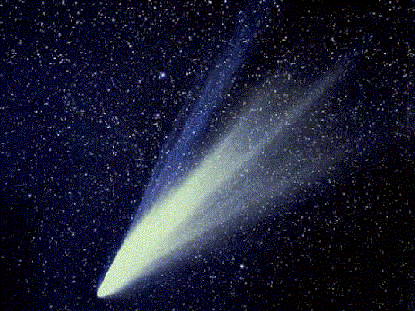
The Sun's radiation pressure and solar wind accelerate materials away from the comet's head at differing velocities according to the size and mass of the materials. Thus, relatively massive dust tails are accelerated slowly and tend to be curved. The ion tail is much less massive, and is accelerated so greatly that it appears as a nearly straight line extending away from the comet opposite the Sun. The following view of Comet West shows two distinct tails. The thin blue plasma tail is made up of gases and the broad white tail is made up of microscopic dust particles.